This is the most important distinction in South African private healthcare funding, and it is the one most frequently misunderstood by consumers. Confusing a medical scheme with a medical insurance product can leave you catastrophically underinsured at precisely the moment you need protection most. This article sets out the differences clearly, and without ambiguity.
The Regulatory Divide
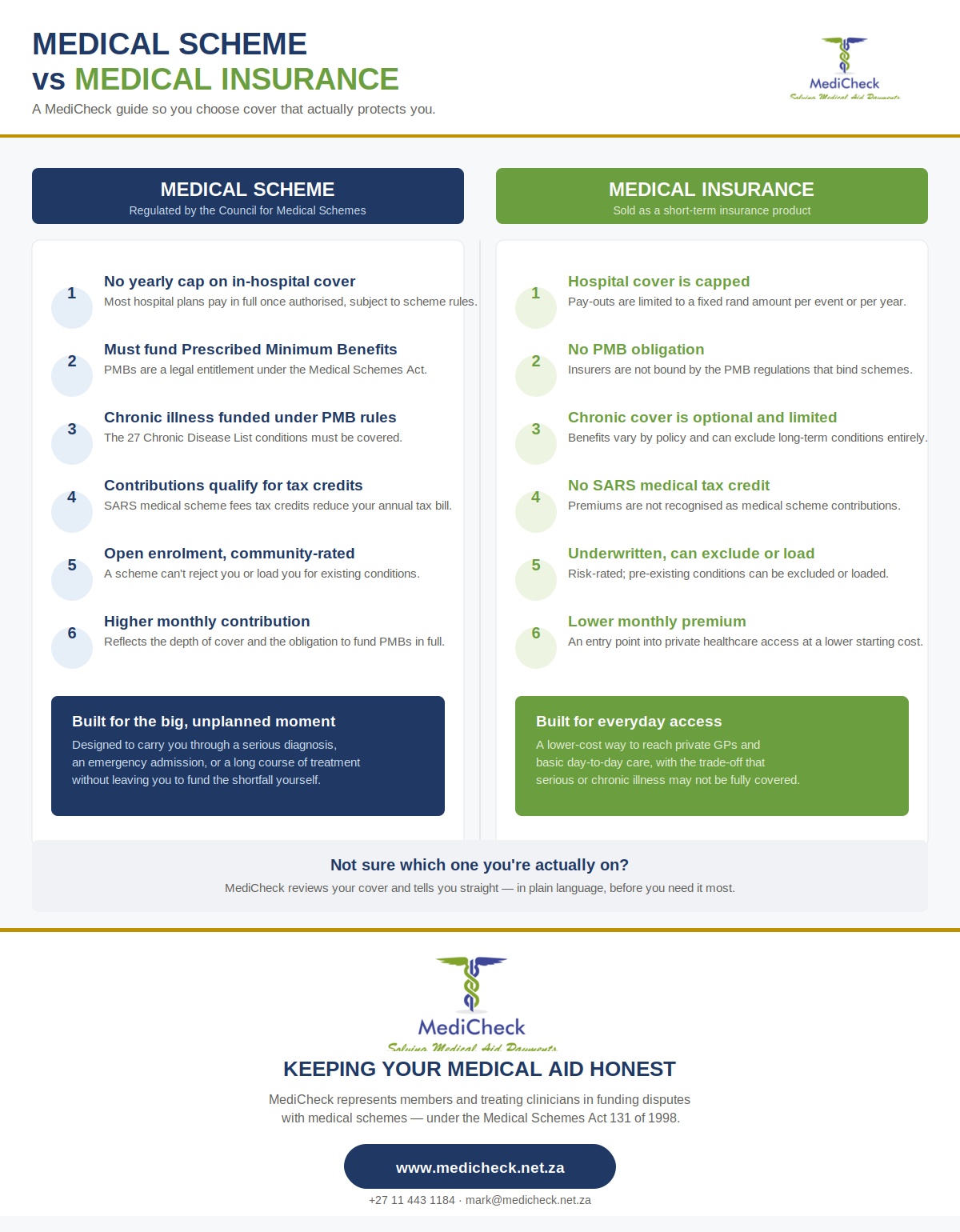
Medical schemes are regulated exclusively under the Medical Schemes Act 131 of 1998, administered by the Council for Medical Schemes. They are not-for-profit entities that pool member contributions for the collective benefit of all members. They are subject to prescribed minimum benefit obligations, solvency requirements, community rating rules, and open enrolment obligations.
Medical insurance products — including hospital plans, gap cover, primary care plans, and health insurance policies — are regulated under the Long-term Insurance Act 52 of 1998 or the Short-term Insurance Act 53 of 1998, administered by the Financial Sector Conduct Authority (FSCA). They are for-profit commercial insurance products. They are not subject to the Medical Schemes Act and carry none of the statutory consumer protections it provides.
This regulatory divide has direct, material consequences for what you are legally entitled to receive when you claim. Medical schemes are obligated by statute. Insurance companies are obligated by contract — and contracts can be written to exclude almost anything.
Hospital Cover — the Critical Difference
A medical scheme, depending on option, provides in-hospital cover that is linked to medical scheme tariffs or negotiated network rates, without a rand-value cap (subject to option limits). A hospital insurance plan provides a fixed daily cash benefit — for example, R2,000 per day of hospitalisation. A five-day admission at a private hospital could cost R150,000 or more. A fixed cash benefit of R10,000 (R2,000 × 5 days) leaves a gap so large it constitutes effectively no meaningful hospital cover at all.
PMB Obligations
Medical schemes are legally required to fund all Prescribed Minimum Benefits — the 270 conditions, 25+ chronic disease categories, and all emergencies — at cost. Medical insurance products have no PMB obligation whatsoever. If your insurance policy does not specifically include a condition, you are not covered for it. There is no regulatory backstop.
Chronic Illness Cover
All registered medical schemes are required to provide cover for the 26 Chronic Disease List conditions as a minimum, regardless of option. Insurance products may offer chronic benefits as an add-on, may cap them at a fixed annual limit, or may exclude pre-existing conditions entirely. The protection is contractual, not statutory, and is therefore inherently less secure.
SARS Tax Credits
Contributions to a registered medical scheme qualify for a medical scheme fees tax credit under Section 6A of the Income Tax Act 58 of 1962. Premium payments to a medical insurance product do not qualify for this credit. For a family of four, the annual tax credit saving on medical scheme contributions is a material figure.
Enrolment Rules and Pricing
Medical schemes must accept all applicants on an open enrolment basis (with the exception of employer-restricted restricted schemes) at community-rated contributions — the same contribution rate applies to all members of the same age category, regardless of health status. A medical insurance product may underwrite based on individual health risk, decline high-risk applicants, or impose pre-existing condition waiting periods that effectively exclude the very conditions for which you most need cover.
MediCheck Tip: If you are currently on a medical insurance product and believe you have medical scheme cover — check your policy documents carefully. Look for the words "registered medical scheme" and the scheme's registration number with the CMS. If you cannot find them, you may have less protection than you think.